

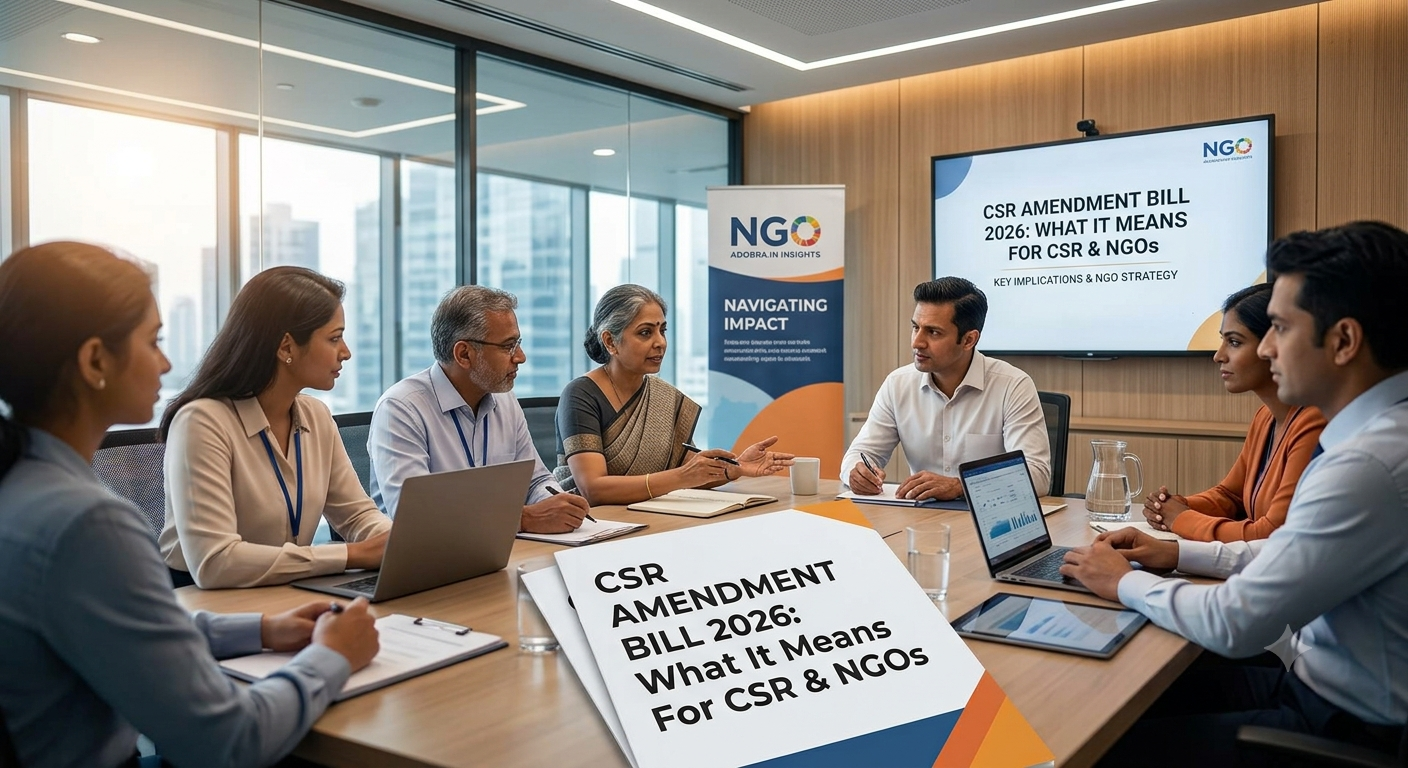
India’s CSR landscape is set for its biggest shift since Section 135 first made corporate social responsibility mandatory in 2014. The Corporate Laws Amendment Bill, 2026, currently before a Joint Parliamentary Committee, proposes changes that will directly affect which companies must spend on CSR, how much flexibility they get, and how NGOs receive and report on that funding.
If you’re a CSR officer, a company director, or an NGO relying on corporate funding, here’s what’s actually changing and what you should do about it now.
- Fewer companies will be required to have a CSR Committee
Currently, any company crossing a ₹5 crore net profit threshold (among other financial criteria) must comply with CSR obligations. The amendment proposes raising this threshold to ₹10 crore.
What this means: Some mid-sized companies that were previously required to run structured CSR programs may no longer be obligated to. If your NGO currently partners with smaller or mid-sized corporate donors, it’s worth understanding whether their CSR obligation status might change once this Bill is notified.
- The CSR Committee exemption limit is also increasing
Companies whose annual CSR spending doesn’t exceed a certain amount are currently exempt from having to form a formal CSR Committee — that exemption limit is rising from ₹50 lakh to ₹1 crore.
What this means: More companies will be able to run CSR programs without a dedicated committee structure, which may mean simpler, faster decision-making — but also less formal oversight. NGOs approaching these companies may find a single CSR officer or director as their primary point of contact rather than a committee.
- Companies get 3x more time to transfer unspent CSR funds
Currently, unspent CSR funds must be transferred to a designated account within 30 days of the financial year ending. The amendment extends this to 90 days.
What this means: If your NGO or foundation has been managing project timelines around this 30-day deadline pressure, expect more flexibility from corporate partners going forward — but also potentially longer waits for fund disbursement in some cases.
- A new funding channel: ZCZP instruments via the Social Stock Exchange
This is the most significant — and least understood — change. Under the new Companies (CSR Policy) Amendment Rules, 2026, companies can now allocate part of their mandatory CSR spend through Zero Coupon Zero Principal (ZCZP) instruments issued by NPOs listed on India’s Social Stock Exchange (SSE).
In simple terms: this is a new, lighter-compliance route for companies to fund NPOs. Notably, Rule 4A(2) exempts this route from the impact assessment requirement that normally applies to larger CSR projects.
What this means for NGOs: If your organization isn’t yet listed on the Social Stock Exchange, this may be worth exploring — it opens a funding channel some corporate donors will increasingly prefer, precisely because it’s simpler for them to deploy and report on.
- Reduced criminal liability for compliance defaults
The Bill proposes shifting certain CSR non-reporting defaults from criminal proceedings to civil penalties. This is part of a broader “ease of doing business” push across the amendment.
What this means: Lower personal risk for company directors around CSR compliance may translate into companies being more willing to experiment with newer, less conventional CSR approaches (like the SSE/ZCZP route above) rather than defaulting to the safest, most conservative options.
What NGOs and CSR teams should do now
- NGOs: Review whether your organization could benefit from Social Stock Exchange listing, especially if you’re seeking diversified corporate funding sources
- NGOs: Don’t assume existing corporate partners’ CSR obligations remain unchanged once the threshold shifts are notified — a check-in conversation is worth having
- Companies: Revisit your CSR policy and committee structure once the Bill is officially notified, since several of these changes affect governance requirements directly
Frequently Asked Questions
Is the Corporate Laws Amendment Bill 2026 already in effect? As of this writing, the Bill remains under review by a Joint Parliamentary Committee and is not yet officially notified. Companies and NGOs should treat these as proposed changes and monitor official MCA notifications before acting on them as final.
Does the CSR threshold change affect all companies? No — it specifically affects companies whose CSR obligation is determined by the ₹5 crore net profit criterion. Companies that qualify under the turnover or net worth criteria under Section 135 are unaffected by this particular change.
What is a ZCZP instrument? A Zero Coupon Zero Principal instrument is a funding instrument issued by NPOs listed on the Social Stock Exchange. It carries no interest and no repayment obligation, functioning effectively as a structured donation instrument that qualifies as CSR expenditure for the contributing company.
Need help understanding how these CSR changes affect your organization’s funding strategy or compliance approach? ADOBRA provides end-to-end CSR and NGO consulting support, from funding & grant research to policy development. Get in touch.